


Decoupling geometric and topological contributions to conformational free-energy landscapes in DNA origami nanosheets

Abstract
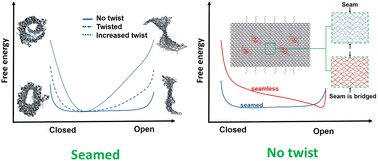
While intrinsic twist and scaffold topologies are known to influence DNA origami mechanics, their independent contributions and coupled effects on directional bending remain quantitatively unresolved. Herein, we perform the first systematic study that simultaneously varies intrinsic twist across six levels (4insert → 4skip) while comparing seamed versus seamless topologies. Using coarse-grained oxDNA simulations and umbrella-sampling free-energy calculations, we quantitatively decouple geometric and topological contributions to conformational energetics. Our analysis reveals that intrinsic right-handed twist independently stabilizes compact conformations and raises opening barriers, while scaffold continuity independently modulates mechanical anisotropy. Together, these effects shape the relative stability of alternative bending pathways, giving rise to directional preferences that evolve continuously across the design space. Crucially, we demonstrate that the combined effects of intrinsic twist and scaffold topology reshape the relative free-energy stability of competing folding pathways. These findings establish a comprehensive twist–topology–directionality framework that enables predictive engineering of DNA nanostructures with targeted conformational preferences and controlled actuation.
 Please wait while we load your content...


