


 PLATFORM UPDATE:


A bimetallic strategy to modulate electronic metal support interaction in Co3O4(111)-based catalysts: the case of supported Rh–Pt core–shell nanoparticles
 a
Alexander
Simanenko,
a
Lukáš
Fusek,
b
Tomáš
Skála,
b
Nataliya
Tsud,
b
Firas
Faisal,
a
Sascha
Mehl,
c
Jörg
Libuda
a
and
Yaroslava
Lykhach
*a
a
Alexander
Simanenko,
a
Lukáš
Fusek,
b
Tomáš
Skála,
b
Nataliya
Tsud,
b
Firas
Faisal,
a
Sascha
Mehl,
c
Jörg
Libuda
a
and
Yaroslava
Lykhach
*a
Abstract
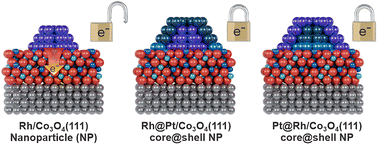
The electronic metal support interaction (EMSI) plays a decisive role in determining the activity, selectivity, and stability of noble metal catalysts supported on reducible oxides. While EMSI can enhance catalytic performance, excessively strong charge transfer at the metal/oxide interface often leads to oxidation and disintegration of metal nanoparticles, particularly in systems such as Rh/Co3O4(111). In this work, we explore how bimetallic Rh–Pt interactions modulate and counteract EMSI at the Rh/Co3O4(111) interface. Two types of core–shell Rh–Pt nanoparticles with precisely controlled compositions and architectures were prepared on well-ordered Co3O4(111) thin films on an Ir(100) substrate and investigated using synchrotron radiation photoelectron spectroscopy. We found that incorporating Pt, either as the core in Pt@Rh or as the shell in Rh@Pt nanoparticles, significantly attenuates charge transfer, thereby stabilizing Rh in its metallic state and suppressing disintegration of the core@shell nanoparticles. This stabilization is attributed to strong Rh–Pt interaction and the ability of the two metals to form stoichiometric binary phases. These findings demonstrate that bimetallic interactions offer an effective strategy to tune EMSI, providing a fundamental basis for the design of electronically balanced and thermally stable catalysts supported on reducible oxides.
 Please wait while we load your content...


