


 PLATFORM UPDATE:


Free energy landscapes of host–guest binding from adaptive bias enhanced sampling†
 a
and
Dhiman
Ray
*ab
a
and
Dhiman
Ray
*ab
Abstract
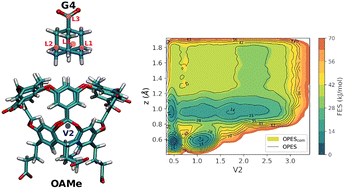
We present a computational framework for calculating the free energy landscapes of host–guest binding using a combination of the on-the-fly probability enhanced sampling (OPES) method and its exploratory variant, OPES-explore. The main advantage of this combined algorithm, referred to as OPESCOM, is its ability to deliver accurate and efficient free energy surfaces using intuitive, suboptimal collective variables that require minimal system-specific optimization. Our algorithm converges the binding affinity estimates within a limited simulation time. It also reproduces the underlying free energy landscapes in quantitative agreement with those generated by much longer OPES simulations that employ sophisticated machine-learned collective variables. Furthermore, the free energy landscapes obtained from the OPESCOM algorithm can identify metastable intermediate states, which can only be distinguished by water coordination descriptors, which are not included in the original set of collective variables used for bias deposition. Thus, it makes the workflow for elucidating host–guest binding mechanisms simple and more scalable without sacrificing accuracy or efficiency. Consequently, our method has the potential to improve computational drug discovery efforts.
- This article is part of the themed collection: Structure and dynamics of chemical systems: Honouring N. Sathyamurthy’s 75th birthday
 Please wait while we load your content...


