


 PLATFORM UPDATE:


Activated graphite carbon-assisted cadmium-doped copper oxide nano catalyst for accelerated photocatalysis and desirable antibacterial activity

Abstract
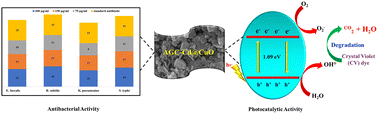
A novel activated graphite carbon (AGC)-assisted Cd-doped CuO (AGC-Cd@CuO) nanocomposite was successfully synthesized via a facile co-precipitation method, representing a new strategy to enhance photocatalytic and antibacterial performance. XRD, FTIR spectroscopy, Raman spectroscopy, FE-SEM, XPS, EPR, HR-TEM, BET and UV-DRS, and Urbach energy analysis have been used in order to examine the properties of the obtained nanocomposites. The novelty of this work lies in the synergistic integration of AGC as a conductive matrix with Cd-doped CuO, enhancing visible-light absorption and suppressing rapid electron–hole recombination, which are key limitations of pristine CuO. The improved photocatalytic performance is attributed to efficient charge separation and interfacial electron transfer facilitated by AGC, along with Cd-induced band structure modulation. The AGC-Cd@CuO nanocomposite exhibited significantly enhanced photocatalytic degradation of crystal violet (CV) dye under UV irradiation compared to pristine CuO and Cd@CuO. It also demonstrated superior antibacterial activity against both Gram-positive and Gram-negative strains. The reduced Urbach energy indicates decreased structural disorder and improved optical properties, contributing to the overall performance. Overall, this study reports, for the first time, an AGC-assisted Cd@CuO nanocomposite with enhanced dual functionality in photocatalytic and antibacterial applications, offering strong potential for environmental remediation.
- This article is part of the themed collection: Physics for Sustainability: Health, Energy, and Environment - SPHERE
 Please wait while we load your content...


