


 PLATFORM UPDATE:


Extended defects in a hard disk system and melting criteria
 *a
*a
Abstract
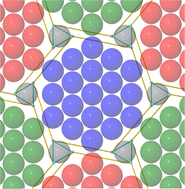
The hard sphere model is widely used in the description of fluids and solid media as a zero approximation to real systems. Despite the uniqueness of the model, few analytical results are known for it, both for the 2D and 3D cases. In the present research, we have investigated the melting of the hard disk system by considering the accumulation of extended defects of a certain type in the crystalline phase, and jamming of the disk packing. This results in the formulation of melting criteria with lower and upper bounds on the volume ratio at the melting transition: 25/21 ≤ Vm/V0 ≤ 5/4. It was found that, in full agreement with the Berezinskii–Kosterlitz–Thouless–Halperin–Nelson–Young theory, the 2D crystal melts into an anisotropic liquid. The second transition, which is the transition between an anisotropic and isotropic liquid, has a volume ratio of 5/4 ≤ Vi/V0 ≤ 13/9.
 Please wait while we load your content...


