


 PLATFORM UPDATE:


The direct-current and alternating-current transport properties of hydrogenated bilayer β12- and χ3-borophenes

Abstract
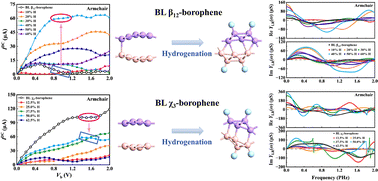
Using density functional theory and the non-equilibrium Green's function method, we investigated the structures, electronic properties, and the direct-current (DC) and alternating-current (AC) transport properties of two-dimensional (2D) hydrogenated bilayer (BL) β12- and χ3-borophenes. We found that when the H coverage is less than 60% for BL β12-borophene and 62.5% for BL χ3-borophene; hydrogenation can enhance the stability of the two BL structures and change the interlayer interaction of BL χ3-borophene from the van der Waals bonds to the covalent bonds. The electronic properties of hydrogenated BL χ3-borophenes still retain anisotropic metallic characteristics, but, for BL β12-borophene, 2D semiconducting structures can also be realized through hydrogenation. Furthermore, our results indicate that hydrogenated BL β12- and χ3-borophenes have rich DC transport properties such as enhanced DC conductance (EDCC), steady DC current (SDCC) and negative differential resistance (NDR) effects. Hydrogenation is an effective way to modulate the NDR-to-SDCC and SDCC-to-NDR transitions. For the AC transport properties, compared with the ML structures, BL β12-borophene exhibits more obvious anisotropy and BL χ3-borophene has stronger inductance in the low-frequency range. In the medium- and high-frequency ranges, different H coverages can significantly affect the critical points and lead to a red-shift or blue-shift phenomenon.
 Please wait while we load your content...


