


 PLATFORM UPDATE:


Perfluorinated alkyl groups induce unexpected hydrophobic hydration structure
 †a
Elio
Casalini,
†b
Jaspreet
Kaur,
a
Sulejman
Skoko,
b
Gerhard
Schwaab,
a
Martina
Havenith
*a
and
Ana
Vila Verde
*b
†a
Elio
Casalini,
†b
Jaspreet
Kaur,
a
Sulejman
Skoko,
b
Gerhard
Schwaab,
a
Martina
Havenith
*a
and
Ana
Vila Verde
*b
Abstract
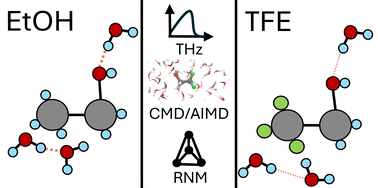
Perfluorination of the terminal methyl group in ethanol gives rise to different thermodynamics of mixing with water. To understand its origin, we probe structure, thermodynamics and collective vibration modes in aqueous solutions of ethanol (EtOH) or 2,2,2-trifluoroethanol (TFE) by using Terahertz (THz) spectroscopy and molecular dynamics simulations. The THz spectra show mainly two features: a mostly entropy-related peak (below 200 cm−1) related to weaker water–water hydrogen bonds, and an enthalpy-related large band above 200 cm−1 related to water–solute hydrogen bonds. The entropic feature is red-shifted for TFE relative to EtOH, consistent with TFE's subpopulation of weaker solvation shell water–water hydrogen bonds found in the simulations. By contrast, the thermodynamics of mixing is dominated by three effects: the higher probability of forming water–water hydrogen bonds in the solvation shell of either solute than in the bulk; the fact that TFE induces a smaller perturbation per water molecule than EtOH, despite perturbing a slightly larger number of water molecules than EtOH, and TFE's weaker solute–water hydrogen bond. The three effects determine the more negative (favourable) enthalpy of mixing and more negative (unfavourable) entropy of mixing of EtOH relative to TFE at low concentrations. The results confirm that hydrophobic solvation of perfluorinated groups is fundamentally different from that of their alkylated equivalents and have implications for the development of models to predict solubility of perfluorinated molecules.
 Please wait while we load your content...


