


 PLATFORM UPDATE:


Molecular dynamics simulations of pH-dependent ciprofloxacin adsorption to Na-montmorillonite
 a
and
Michael
Holmboe
*a
a
and
Michael
Holmboe
*a
Abstract
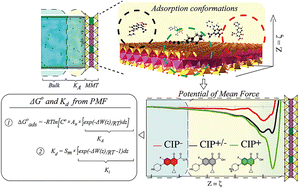
Ciprofloxacin (CIP) is one of the most widely used and environmentally persistent antibiotic compounds, which is increasingly being found in soils, sediments, and natural waters. Because CIP strongly associates with clay minerals, understanding its molecular-scale adsorption energetics, dynamics, and configurations is essential for predicting environmental retention and mobility. For this purpose, a combination of unbiased molecular dynamics simulations, biased umbrella sampling and alchemical free-energy perturbation simulations were used in this study to obtain the free energy of adsorption, orientational and clustering configurations and interlayer density mapping across controlled hydration states. These simulations were applied to the three pH-dependent environmentally relevant CIP species (CIP+, CIP+/−, CIP−) interacting with montmorillonite (MMT) in its Na+ form, at basal surfaces and within variably hydrated interlayers. All CIP species approached similar center-of-mass separations from the MMT surface but adopt distinct orientational preferences: CIP+ binds predominantly flat, CIP+/− partitions between flat and side-on, and CIP− samples multiple poses. The potential of mean force profiles revealed that all species adsorb favourably, but with adsorption strengths steeply increasing in the order CIP− < CIP+/− < CIP+, having standard adsorption free energies of −2.1, −11.8 and −30.0 kJ mol−1, with corresponding sorption Kd values of 6.4, 520, and 1.0 × 106 cm3 g−1, respectively. Unbiased open systems simulations further showed that CIP+ and CIP+/− could be intercalated into 2 W and 3 W hydration states, whereas CIP− failed to intercalate below 4 W. The free energy perturbation simulations revealed the largest hydration free energy for CIP− across bulk, mesopore, and surface environments, while CIP+/− and especially CIP+ experience increasingly favourable hydration near the clay surface due to enhanced water structuring and electrostatic potential. Overall, this study reconciles flat versus tilted pose hypotheses and links pH-driven speciation to MMT retention and mobility. The results explain, on the molecular scale, why clay-rich soils act as strong sinks and how montmorillonite colloids can promote colloid-facilitated transport of antibiotics in real soil-aquifer systems.
 Please wait while we load your content...


