


 PLATFORM UPDATE:

Effects of modified silica on the interfacial behaviour of polypropylene/ammonium polyphosphate composites: a molecular dynamics study
 *ab
*ab
Abstract
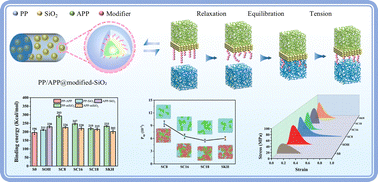
Ammonium polyphosphate (APP), as an eco-friendly halogen-free flame retardant, is commonly applied in non-polar polymers like polypropylene (PP). However, the poor compatibility between polar APP and non-polar PP leads to issues like APP migration and inferior mechanical properties. To investigate a potential route to mitigate this incompatibility, we designed various silica (SiO2) models as coating agents, including unmodified SiO2 and SiO2 modified with octyltriethoxysilane (OTES), octadecyltrimethoxysilane (OTS), hexadecyltrimethoxysilane (HDTMS), and γ-methacryloxypropyltrimethoxysilane (KH570). These specific grafting agents were selected because of their structural similarity to PP. Using molecular dynamics simulation, we investigated how these models regulate the interfacial behavior and mechanical properties of PP/APP composites. The results show that the enhancement in interfacial binding energy achieved by different silica models varies significantly with the specific surface modifier employed, with the OTES-modified system exhibiting the highest increase of approximately 49%. Moreover, SiO2 incorporation improved the composite yield strength by 100–128%, confirming enhanced interfacial interaction and mechanical performance. The temperature-dependence study further revealed that the OTES-modified SiO2 system exhibited the best interfacial stability at 300 K, and as the temperature increased, its interfacial properties gradually deteriorated. In conclusion, this study provides valuable molecular-level insights into improving the compatibility of flame retardants in polymers and enhancing the mechanical properties of composites. Furthermore, the results offer theoretical guidance and technical support for the design of high-performance PP/SiO2/APP nanocomposites.
 Please wait while we load your content...


