


 PLATFORM UPDATE:


Interaction energies and stabilities of heteroatom-containing aromatic compounds on graphite
 *a
and
Seiji
Tsuzuki
*b
*a
and
Seiji
Tsuzuki
*b
Abstract
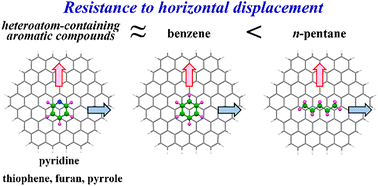
Stacked structures based on π–π stacking interactions have been widely observed in natural and artificial self-assembled systems composed of polycyclic aromatic compounds containing carbon and heteroatoms. While previous studies have quantitatively evaluated the interaction energies (Eint) and their variations with horizontal displacement (ΔEint) for polycyclic aromatic hydrocarbons (PAHs), such intermolecular interactions for heteroatom-containing aromatic compounds (HACs) incorporating elements such as sulphur, oxygen, or nitrogen remain largely unexplored. In this study, we evaluated Eint and ΔEint of HACs on a graphite model surface (C96H24) using dispersion-corrected density functional theory calculations. The Eint values of thiophene (−10.09 kcal mol−1) and pyridine (−10.31 kcal mol−1) were found to be comparable to those of benzene (−10.55 kcal mol−1), whereas those of furan (−8.13 kcal mol−1) and pyrrole (−9.18 kcal mol−1) were lower (less negative). In all cases, the Eint values were smaller than those of n-alkanes containing the same total number of carbons and heteroatoms. The dispersion force plays the dominant role in the attractive interactions between the HACs and C96H24. It was found that Eint increases linearly with the number of heavy (non-hydrogen) atoms of HACs and benzene-fused HACs, similar to the results obtained for PAHs. The stability against horizontal displacement of thiophene, furan, pyrrole and pyridine, as inferred from the changes in ΔEint was also similar to that of benzene, but lower than that of n-pentane. These results indicate that the presence of heteroatoms does not significantly affect the interaction energies or stacking stabilities, implying that the introduced HACs can be treated almost identically to PAHs in terms of their interaction energies and stability of stacking with graphite.
 Please wait while we load your content...


