


HONO, a key sink of isoprene-derived Criegee intermediates (MACR-oxide and MVK-oxide)

Abstract
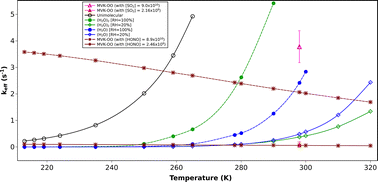
In the present work, we have investigated the bimolecular reactions of biogenic (methyl vinyl ketone oxide (MVK-OO) and methacrolein oxide (MACR-OO)) and anthropogenic (acetaldehyde oxide (CH3CHOO)) Criegee intermediates with nitrous acid (HONO) using quantum chemical calculations and kinetic modelling. For quantum chemical calculations, we used the CCSD(T)/CBS//M06-2X/aug-cc-pVTZ level of theory, while for the rate constant calculation, we carried out Rice–Ramsperger–Kassel–Marcus theory/master equation kinetics calculations. Our study suggests that HONO can serve as a major bimolecular sink for MVK-OO, whereas it acts as a minor sink for MACR-OO, becoming significant only under low-humidity and low-temperature conditions. For CH3CHOO, HONO acts as the most dominant sink (relative to H2O and (H2O)2) after unimolecular decay. Overall, the findings suggest that HONO can act as a potential sink for Criegee intermediates in both biogenic (forested) and anthropogenic (urban) environments.
 Please wait while we load your content...


