


Strain-tunable antiferroelectricity in 2D CuCrP2S6 for high-performance neuromorphic devices
 *ab
and
Aijun
Du
cd
*ab
and
Aijun
Du
cd
Abstract
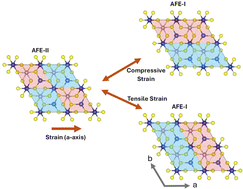
Neuromorphic computing, inspired by the architecture of the human brain, offers efficient and scalable hardware solutions for AI applications. Antiferroelectric (AFE) materials are promising for such applications due to their large number of intermediate polarized states. In this study, we investigate monolayer CuCrP2S6 (CCPS), a layered material that has two unique AFE (I and II) phases. The AFE-II phase allows ferroelectric (FE) domains to be as small as a single unit cell, addressing challenges such as cycle-to-cycle and device-to-device variations, as well as the limited number of intermediate states in neuromorphic systems. The material exhibits a unique response to mechanical strain, enabling modulation between the AFE-II and AFE-I phases. Additionally, depending on whether the applied strain is compressive or tensile, the FE domain patterns can be tuned. Applying tensile strain along the a-axis results in FE domains extending along the b-axis, whereas applying compressive strain along the a-axis leads to domain continuation along the same a-axis, forming stripe-like FE domains. Band structure analysis reveals significant anisotropy in the electronic properties of the AFE-I phase, while magnetic anisotropy is also present, albeit with a smaller magnitude. This anisotropy enables phase and FE domain pattern identification using electrical properties. Additionally, we demonstrate possible polarization switching pathways through different AFE states, outlining the broad landscape of available intermediate FE states and domain kinetics inherent to CCPS. These findings highlight the untapped potential of not only CCPS but also other AFE materials for application in next-generation neuromorphic and electronic systems, offering new avenues for device functionality and design.
 Please wait while we load your content...


