


 PLATFORM UPDATE:

Insights into phonons and spin–lattice relaxation in copper(ii) and vanadyl(iv) porphyrin metal–organic frameworks from density functional theory

Abstract
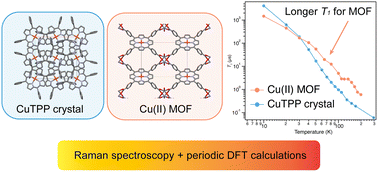
Employing metal–organic frameworks (MOFs) has been shown to be an effective strategy for extending spin–lattice relaxation times (T1) by modifying the vibrational properties of molecular spin qubits. Although a previous study employed terahertz spectroscopy to probe vibrational properties, the specific types of vibrational modes that affect T1 have remained unclear. In this study, we use periodic density functional theory calculations to investigate the vibrational properties of the MOF [{M(TCPP)}Zn2(H2O)2] (M = Cu, VO, and TCPP = tetrakis(4-carboxyphenyl)porphyrin) and the corresponding molecular crystals MTPP (TPP = tetraphenylporphyrin). Although the longer T1 of the vanadyl MOF compared to the VOTPP crystal has been attributed to the absence of low-frequency modes, our combined experimental Raman spectra and phonon simulations show that the mere presence of low-frequency modes does not necessarily lead to faster relaxation times. To rationalize the differences in T1 between the MOFs and the corresponding molecular crystals, we calculated the spin–phonon coupling (SPC) for each Γ-point phonon mode. Furthermore, we analysed correlations with the magnitude of the SPCs, the symmetry of the modes, and the in-plane and out-of-plane distortion of the porphyrin framework. Our results reveal that no single descriptor (frequency, symmetry, or distortion magnitude) can reliably predict the SPC strength, highlighting the multifactorial nature of the SPCs in these systems. This complexity underscores the importance of explicit computational treatments for identifying the key phonon modes that drive spin–lattice relaxation, while spectroscopic techniques such as low-frequency vibrational spectroscopy can provide complementary validation and qualitative insights.
 Please wait while we load your content...


