


 PLATFORM UPDATE:

Electronic transport in antiaromatic molecules
 a
Fernando
Martínez-Villarino,
b
Filiberto
Ortíz-Chi,
b
Thomas
Stegmann,
*a
François
Leyvraz
*a
and
Mesías
Orozco-Ic
*a
a
Fernando
Martínez-Villarino,
b
Filiberto
Ortíz-Chi,
b
Thomas
Stegmann,
*a
François
Leyvraz
*a
and
Mesías
Orozco-Ic
*a
Abstract
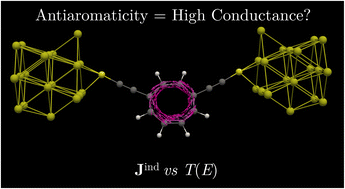
In recent years, it has been suggested that antiaromaticity may, under certain conditions, enhance electron transport. Here, we explore this relationship by analyzing a representative series of antiaromatic molecules, ranging from small and large monocyclic systems to polycyclic molecules. Using density functional theory combined with non-equilibrium Green's function methods, together with a nearest-neighbor tight-binding model, we compute electron transmission and assess aromaticity via magnetic response calculations. We find that strong antiaromaticity is typically associated with sharp antiresonances and suppressed transmission near the Fermi level. However, in larger systems, destructive interference is displaced from the Fermi level, allowing an improved conductance. These results reveal that antiaromaticity alone is not a reliable predictor of poor or enhanced transport. Instead, the topological distribution of ring currents, the ring size, and the position of the contacts in the molecule emerge as critical factors. This work clarifies the electronic consequences of antiaromaticity in molecular transport and provides guidelines for designing functional molecular switches based on antiaromatic building blocks.
 Please wait while we load your content...


