


Thermoelectric performance of Janus monolayers embedded in MX2-based superlattices: a computational insight

Abstract
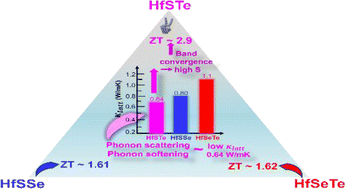
In this study, we explore a strategy to enhance the thermoelectric (TE) performance of materials by constructing Janus-embedded superlattices (SLs), where the incorporation of Janus layers at the internal interfaces and van der Waals (vdW) interactions collectively modulate electronic and phonon transport properties. Using first-principles density functional theory (DFT) and Boltzmann transport theory, we investigate three SL configurations—HfSe2/HfSSe/HfTe2, HfSe2/HfSTe/HfTe2, and HfSe2/HfSeTe/HfTe2—designed by embedding a Janus MXY (M = Hf; X/Y = S, Se, and Te) monolayer between conventional HfSe2 and HfTe2 layers. The asymmetric Janus interface induces significant modifications in electronic structure and phonon dynamics, including strong band convergence, phonon bunching, and ZO mode softening, which collectively enhance TE transport. Among the three systems, HfSTe exhibits the most favourable properties, highest Seebeck coefficient (2438 µV K−1), strong phonon scattering, and ultralow lattice thermal conductivity (0.65 W m−1 K−1) leading to a peak ZT of ∼2.94 for p-type and ∼0.95 for n-type at 700 K. The corresponding energy conversion efficiency reaches 17.3% for p-type carriers. Interestingly, for n-type, HfSeTe achieves the highest ZT value (∼1.62), primarily attributed to its superior electrical conductivity. Our results reveal that interface engineering through Janus embedding and vdW interaction is a robust strategy for optimizing the thermoelectric performance of TMD-based layered materials.
 Please wait while we load your content...


