


 PLATFORM UPDATE:


A silicon single atom anchored on an α-BS monolayer for efficient electrocatalytic nitric oxide reduction to ammonia
 c
and
Linxia
Wang
*a
c
and
Linxia
Wang
*a
Abstract
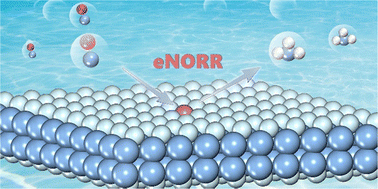
The development of efficient, low-cost, and environmentally friendly metal-free electrocatalysts is crucial for the green conversion of nitric oxide (NO) into ammonia (NH3). Herein, we designed a series of non-metal single-atom catalysts (XS@BS, X = B, C, N, O, Si, P, As, and Se) by substituting a sulfur atom in the α-BS monolayer. Their structural stability, NO activation capability, and performance toward the electrocatalytic NO reduction reaction (eNORR) were systematically investigated using first-principles density functional theory (DFT) calculations. Among these systems, SiS@BS demonstrates the highest eNORR activity via the N-alternating pathway, with a positive limiting potential of 0.33 V, ensuring that the reaction can proceed spontaneously under standard conditions. Furthermore, SiS@BS effectively suppresses the competing hydrogen evolution reaction and prevents the formation of undesired byproducts (N2O and N2). The robustness of SiS@BS was further validated by AIMD simulations at room temperature. The superior performance is attributed to the balanced energy profile, enabled by the effective hybridization between the p orbital of Si and the 1π* orbital of NO, which facilitates efficient N–O bond activation while avoiding the over-stabilization of subsequent intermediates. This study provides theoretical guidance for the rational design of cost-effective metal-free eNORR catalysts.
 Please wait while we load your content...


