


 PLATFORM UPDATE:

Two-stage transfer learning for deep learning-based prediction of lattice thermal conductivity
 *a
and
*a
and
Abstract
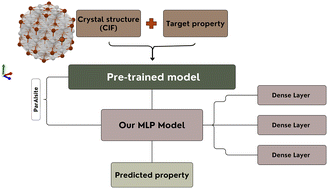
Machine learning promises to accelerate material discovery by enabling high-throughput prediction of desirable macro-properties from atomic-level descriptors or structures. However, the limited data available about precise values of these properties has been a barrier, leading to predictive models with limited precision or ability to generalize. This is particularly true of lattice thermal conductivity (LTC): existing datasets of precise (ab initio, DFT-based) computed values are limited to a few dozen materials with little variability. Based on such datasets, we study the impact of transfer learning on both the precision and robustness of a deep learning model (ParAIsite). We start from an existing model (MEGNet 1) and show that significant improvements in predicting high-quality approximations of LTC are obtained through applying transfer learning twice: once on the basis of a pre-training of the model on a large number of materials for a different task (predicting formation energy), and a second time using a medium size dataset (a few thousand materials) of low-quality approximations of LTC (based on the AGL workflow). In other words, greater precision and robustness is obtained after a final training (fine-tuning) of the twice pre-trained model with our high-quality, smaller-scale dataset. We also analyze results obtained from using this higher-precision deep-learning model to scan large numbers of materials from the Material Project Database, in search of low-thermal-conductivity compounds.
 Please wait while we load your content...


