


 PLATFORM UPDATE:


Unraveling the H2/BMo interface: orientation-driven adsorption landscapes for hydrogen storage design

Abstract
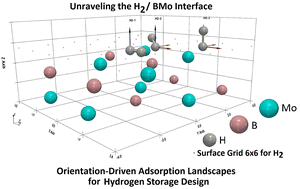
The rational design of hydrogen storage materials requires a deep understanding of gas–surface interactions. This study utilizes high-throughput density functional theory (DFT) to comprehensively map the H2 adsorption landscape on the BMo (001) surface by screening 1728 distinct molecular configurations. The surface exhibits a remarkably homogeneous energy distribution, evidenced by negligible spatial correlations. However, the adsorption strength demonstrates a clear dependence on molecular orientation, being modulated by the tilt angle, while the azimuthal angle governs the spatial distribution of optimal binding sites. We identify specific molecular alignments that function as “hot spots” for spontaneous chemisorption, with energies as low as −0.25 eV. The resulting complex energy distribution reveals a “gated” adsorption landscape where strong binding is accessible only through these specific orientations. This work elucidates the critical role of molecular orientation in H2 binding and establishes key design principles for boride-based hydrogen storage materials, demonstrating the power of combinatorial screening for deciphering complex interface phenomena.
 Please wait while we load your content...


