


 PLATFORM UPDATE:


Combining classical reactive scattering and the time–energy uncertainty relation
 *a
and
*a
and
Abstract
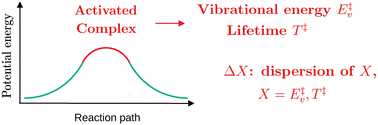
Gaussian binning is a method for analyzing the results of classical dynamical simulations of gas-phase and gas-surface reactions that has been used since the early 2000s in order to improve predictions of state-resolved cross sections and related quantities measured in molecular beam experiments. In this method, classical trajectories are assigned Gaussian statistical weights, with much higher weights given to product energies closer to their quantized values. Here, we extend this idea to the activated complex in two ways: (i) treating it as if it were in a stationary state, just like the products, which requires as narrow a Gaussian as possible, and (ii) considering the activated complex as being in a time-dependent state, broadening the Gaussian so that the statistical properties of the activated complex are consistent with the time–energy uncertainty relation. The latter approach, which builds on a recent semiclassical study of chemical reaction thresholds [L. Bonnet, C. Crespos and M. Monnerville, J. Chem. Phys., 2022, 157, 094114], is coupled with simple calculations of tunneling through adiabatic barriers in the parabolic limit. The resulting methods are then used to calculate the reaction probability for two model processes involving, respectively, long-lived and short-lived activated complexes. The agreement with quantum probabilities appears to be very good. Based on these results, the shapes of quantum probabilities are analysed from the classical dynamics and the time–energy uncertainty relation. The question of zero-point energy violation at the transition state is examined in light of the preceding results.
- This article is part of the themed collection: Structure and dynamics of chemical systems: Honouring N. Sathyamurthy’s 75th birthday
 Please wait while we load your content...


