


 PLATFORM UPDATE:


Energetic, geometric, electronic and magnetic properties of transition-metal-substituted binary CAs3 Dirac monolayers

Abstract
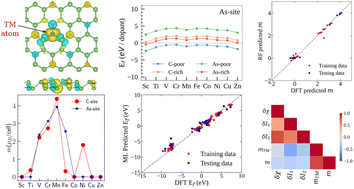
Two-dimensional magnetic materials have recently emerged as promising candidates for spintronics, optoelectronics, and next-generation sensing technologies. Magnetic doping of Dirac semimetals breaks time-reversal symmetry, thereby inducing anomalous transport phenomena. Using density functional theory (DFT) calculations, we systematically investigate the stability, structural, electronic, and magnetic properties of 3d transition-metal (TM)-substituted CAs3 Dirac monolayers, considering both single (1.4%) and double (2.8%) substitutional doping at C- and As-sites. The resulting magnetic properties strongly depend on the substitutional site and the filling of the d-orbitals of TM atoms. Mn substitution yields the maximum magnetic moment of 4µB per cell. The results reveal that the substitution of V, Cr, Mn, and Fe atoms induces a finite magnetic moment in the pristine CAs3. The substitution of TM atoms is found to break the inversion symmetry and reduce the lattice symmetry, resulting in band splitting and the opening of a finite gap at the Dirac point. The calculated formation energies under different chemical potential limits (C- and As-rich or -poor) strongly influence the feasibility of TM doping in CAs3. Under C-poor conditions, doping at the As-site is energetically preferred, whereas C-site substitution becomes favorable under C-rich and As-poor conditions for single TM substitution. The magnetic behavior of double TM (Cr, Co) substitution exhibits either magnetic or nonmagnetic behavior depending on whether the dopants occupy near or far sites. To predict formation energies, we develop a tree-based machine learning model, random forest, for formation energy prediction using atomic descriptors. The coefficient of determination R2 value is found to be 0.98 for the testing data. The electrical conductivity of the doped systems is calculated using Boltzmann transport theory within the constant relaxation time approximation.
 Please wait while we load your content...


