


 PLATFORM UPDATE:


Six-dimensional intermolecular potential energy surface and vibrational states of the benzene–methane vdW complex

Abstract
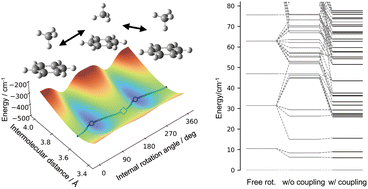
We have developed a six-dimensional (6D) model to describe the intermolecular potential energy surface (IPS) pertinent to binary van der Waals (vdW) complexes composed of a benzene (Bz) and a small molecule X. In the present formalization, termed the coupled-stretch-bend-internal-rotation (CSBI) model, the longitudinal displacement of X from the Bz plane (as vdW stretch), the 2D displacements of X parallel to the Bz ring (vdW bend), and the 3D internal rotation of X inside the complex are taken as internal coordinates, and the IPS is composed of symmetry-adapted terms, which are expanded as explicit functions of the coordinates. Here, Bz–methane has been chosen to apply the model because of its importance to gain a detailed understanding of the C–H/π interaction. Quantum chemical calculations at the CCSD(T)/aug-cc-pVTZ level of theory have been conducted to obtain single-point energies of 525 grids for various complex conformations, and the calculated results have been processed with the least-squares regression to determine potential parameters in the CSBI model. The thus constructed IPS has shown that in the most stable conformation, the methane resides on the aromatic ring (with an intermolecular distance of 3.712 Å), pointing one of its C–H bonds to the center of the Bz ring. The barrier for the internal rotation along the minimum energy path is moderately low (of 57 cm−1). The IPS exhibits substantial coupling between the three coordinate spaces, and effects of such mode coupling can be visualized as the difference in the potential profiles with and without the coupling terms. Eigenstates for the intermolecular motion have been determined by diagonalizing the full Hamiltonian matrices with the CSBI potential. Character of each eigenstate is assessed by examining its composition projected onto the basis functions as well as vibrationally averaged geometrical parameters.
 Please wait while we load your content...


