


 PLATFORM UPDATE:


Bandgap engineering and edge-state delocalization in Si-substituted zigzag graphene nanoribbons for multilayer p–n junction solar cells: a theoretical investigation

Abstract
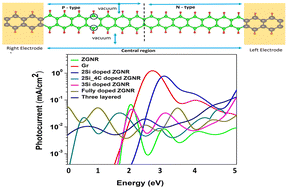
Graphene and silicon are among the most promising candidates for nanotechnological applications owing to their exceptional electronic and structural properties. In this study, we investigate the integration of silicon (Si) with zigzag-edge graphene nanoribbons (ZGNRs) for potential solar cell applications. Using the density functional theory (DFT) framework combined with the non-equilibrium Green's function (NEGF) approach, we explore the electronic and photovoltaic characteristics of Si-substituted ZGNR p–n multilayer junction devices under varying substitution concentrations. The localized charge density associated with the edge states of pristine ZGNR results in distinctive electronic behaviour. However, our results suggest that upon Si incorporation, these charges become partially delocalized through the formation of Si–C bonds, leading to a transition of ZGNRs from metallic to semiconducting. This electronic transformation has a notable influence on light absorption, photocurrent generation, and overall photovoltaic performance. A Si-substituted ZGNR p–n multilayer solar cell device is subsequently designed, where the bandgap of each atomic layer is tuned by optimized silicon substituted concentrations. The device exhibits a monotonic increase in photocurrent with photon energy, a consequence of improved light absorption efficiency. While pristine ZGNRs are not inherently active photovoltaic materials, our findings demonstrate that silicon substitution substantially enhances their electronic and photovoltaic properties.
 Please wait while we load your content...


