


 PLATFORM UPDATE:


Conformational studies of 1,2-di-tert-butoxyethane with special attention to the gauche oxygen effect

Abstract
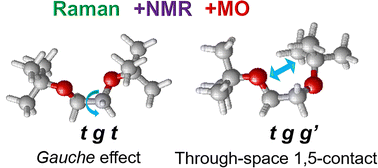
Polyoxyethylene and its derivatives are highly soluble in both water and conventional organic solvents, and are widely used for many applications. Their usefulness is largely due to the ethylene glycol (EG) unit that makes up the chain. In order to understand the unique properties of the chain, many studies have been reported on its monomeric model compound, 1,2-dimethoxyethane (DME). We have attempted to study how substitution of the terminal methyl by bulky nonpolar groups affects the through-space 1,5-interaction and consequently the gauche oxygen effect of the central C–C bond. Conformational analysis of 1,2-di-tert-butoxyethane (DTBE, X–OCH2–CH2O–X with X = t-butyl) was carried out using Raman spectroscopy, with supplementary use of NMR and quantum chemical calculations. Introduction of the t-butyl groups should largely enhance the hydrophobicity of the molecular environment, yet DTBE was found to be soluble in water. While bond rotations around the terminal X–O bonds are significantly constrained, the gauche preference around the central C–C bond was found to be less affected. While electrostatic interactions play an important role in the non-hydrogen-bonding media, hydrogen-bonding comes into play in the solvents capable of forming intermolecular hydrogen-bonds. Unexpectedly, some observable amount of the through-space 1,5-t-Bu⋯O contact characteristic of the tgg′ conformation was detected in DTBE in the gas phase. Unlike DME, however, such electrostatic attractions are completely suppressed in the condensed phase. These results indicate that the gauche oxygen effect of EG units is not necessarily related to the through-space 1,5-contact involving adjacent C–O bonds.
 Please wait while we load your content...


