


 PLATFORM UPDATE:


Ga-induced electronic tuning of Ni catalyst surfaces: achieving activity–selectivity balance in propane dehydrogenation
 *a
Xingyuan
Chen
c
*a
Xingyuan
Chen
c
Abstract
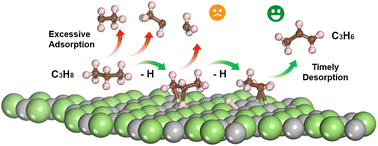
Propane dehydrogenation (PDH) plays a vital role in the industrial production of light olefins. However, a comprehensive and profound understanding of the catalyst surface governing the active site structures in C–H activation pathways and product selectivity remains elusive. In this study, first-principles calculations were systematically employed to investigate the influence of varying Ga doping ratios on Ni-based catalyst surfaces from multiple perspectives. The configurational evolution and associated energy barriers of key reaction species, including adsorbed propane, reaction intermediates, and relevant transition states, were systematically analyzed. Moreover, the reaction energy on the surface of each catalyst was analyzed from fundamental electronic properties, such as d-band structures, orbital-level interactions, and charge transfer. Our findings revealed that Ga could simultaneously tune the electronic structure and spatial orbital overlap, establishing activity–selectivity balance that represents a potential approach for alloy catalyst design beyond the limitations of conventional d-band descriptors. These theoretical predictions were corroborated by experimental results. Ni3Ga exhibited excellent pathway control while maintaining high catalytic activity and selectivity of propylene from both theoretical and experimental perspectives. Beyond mechanistic understanding, this balance gives a design principle for non-precious alloy catalysts, offering a forward-looking strategy for other heterogeneous catalytic reactions.
 Please wait while we load your content...


