


 PLATFORM UPDATE:


Combined influence of the QM methods, active space size, Franck–Condon approximation, Herzberg–Teller effect and Duschinsky effect on vibrationally resolved electronic spectra: insights from firefly oxyluciferin

Abstract
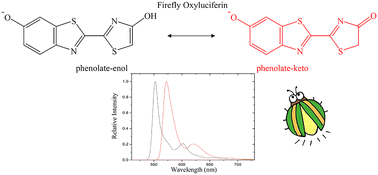
Theoretical simulations of vibrationally resolved electronic spectra not only allow direct comparison with experimental results but also enable simulations under conditions that are experimentally challenging, such as in the gas phase. For instance, firefly oxyluciferin (OL) exists in six neutral and ionic forms in equilibrium within a physiologically relevant pH range in aqueous solutions. Investigating the absorption and fluorescence spectra of OL helps in elucidating the mechanism of firefly bioluminescence and reveals its photophysical properties, thereby enabling control of the emission color. Recent experiments have investigated its absorption and fluorescence spectra in the gas phase, revealing that oxyluciferin anion (OL−) can exist in both phenolate-enol and phenolate-keto forms. In this study, we present a simulation of the vibrationally resolved absorption and fluorescence spectra of four OL− derivatives, namely, phenolate-enol, phenolate-keto, meo-OL− (enol-locked) and dm-OL− (keto-locked). Our spectra simulation employs several electronic structure methods, including time-dependent density functional theory (TDDFT), complete active space second-order perturbation theory (CASPT2), and density matrix renormalization group (DMRG) CASPT2. In addition, we studied the influence of quantum mechanics (QM) methods, active space size, the Herzberg–Teller effect, and the Duschinsky effect on the spectra simulation. The simulated spectra not only agree well with experimental results but also detail the experimental findings, revealing key vibronic transitions of OL− derivatives. The combination of CASPT2 and TDDFT calculated that the 0-0 transition energy can be directly used as a reference for the band origin when it is not reported experimentally. Our findings can also be extended to simulate the absorption and fluorescence spectra of other semirigid organic molecules.
 Please wait while we load your content...


