


 PLATFORM UPDATE:


Dissecting binding and immune evasion mechanisms for ultrapotent Class I and Class 4/1 neutralizing antibodies of SARS-CoV-2 spike protein using a multi-pronged computational approach: neutral frustration architecture of binding interfaces and immune escape hotspots drives adaptive evolution

Abstract
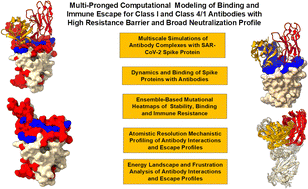
The relentless evolution of SARS-CoV-2 underscores the urgent need to decipher the molecular principles that enable certain antibodies to maintain exceptional breadth and resilience against immune escape. In this study, we employ a multi-pronged computational framework integrating structural analysis, conformational dynamics, mutational scanning, MM-GBSA binding energetics, and the landscape-based frustration profiling of the RBD-antibody interactions to quantify the mechanisms of ultrapotent neutralization by a cohort of broadly reactive Class 1 antibodies (BD55-1205, 19–77, ZCP4C9, ZCP3B4) and the Class 4/1 ADG20 antibody. We reveal a unifying biophysical architecture driving binding for Class 1 antibodies that exploit pre-configured interfaces and distribute binding energy across extensive epitopes through numerous suboptimal yet synergistic interactions. Mutational scanning identifies a hierarchical hotspot organization where primary hotspots (e.g., H505, Y501, Y489, Y421), which overlap with ACE2-contact residues and incur high fitness costs upon mutation, are buffered by secondary hotspots (e.g., F456, L455) that are more permissive to variation. MM-GBSA energy decomposition confirms that van der Waals-driven hydrophobic packing dominates binding, with primary hotspots contributing disproportionately to affinity, while electrostatic networks provide auxiliary stabilization. Conformational and mutational frustration analyses demonstrate that immune escape hotspots reside in neutral-frustration “playgrounds” that permit mutational exploration without destabilizing the RBD, explaining the repeated emergence of convergent mutations across lineages. Our results establish that broad neutralization arises not from ultra-high-affinity anchors, but rather from strategic energy distribution across rigid, evolutionary interfaces. By linking distributed binding, neutral frustration landscapes, and viral fitness constraints, this framework provides a predictive blueprint for designing next-generation therapeutics and vaccines capable of withstanding viral evolution.
 Please wait while we load your content...


