


 PLATFORM UPDATE:


A polymeric α-tetrasubstituted CoII-phthalocyanine catalyst for stable and selective electrochemical carbon dioxide reduction

Abstract
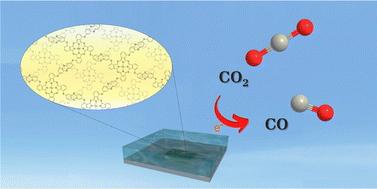
The development of efficient molecular catalysts for electrochemical CO2 reduction (ECO2R) remains a key challenge for scalable carbon utilization. Herein, we report the synthesis and electropolymerization of an α-tetraamino-substituted CoII-phthalocyanine monomer (CoPc-1α) to yield robust polymer films (p(CoPc-1α)) on various conductive substrates. The resulting films were characterized by UV-visible spectrophotometry, Raman and attenuated total reflection-Fourier transform infrared (ATR-FTIR) spectroscopy, scanning electron microscopy (SEM) equipped with energy dispersive X-ray spectroscopy (EDX), variable frequency square-wave voltammetry (VF-SWV), and density functional theory (DFT), confirming successful polymer network formation via phenazine linkages and efficient electron transfer across macrocyclic units. In H-cell electrolysis at −1.15 V vs. NHE, a p(CoPc-1α)-modified carbon paper electrode exhibited high selectivity for CO generation with a faradaic efficiency (FECO) of 97%, along with a current density of 3.8 mA cm−2 and a turnover number (TONCO) and a turnover frequency (TOFCO) of 6.0 × 10⁴ and 0.37 s−1, respectively, over 45 h. At an applied potential of −1.54 vs. NHE in a flow-cell system, the p(CoPc-1α) film on a microporous layer of a carbon fiber paper exhibited remarkable catalytic performance, achieving an average current density of 151 mA cm−2 with 98% FECO for 42 h, corresponding to a TONCO of 1.9 × 10⁶ and a TOFCO of 12.6 s−1. This study demonstrates that p(CoPc-1α) offered a balanced profile of high selectivity, long-term stability and practical current output, establishing it as a promising material for scalable CO2-to-CO conversion.
- This article is part of the themed collection: Advances in computational chemistry and catalysis: Honouring Jumras Limtrakul’s 72nd birthday
 Please wait while we load your content...


