


 PLATFORM UPDATE:


Machine learning for accelerated prediction of size distributions of spherical nanoparticles from small-angle X-ray scattering
 †a
Wancheng
Yu
*a
†a
Wancheng
Yu
*a
Abstract
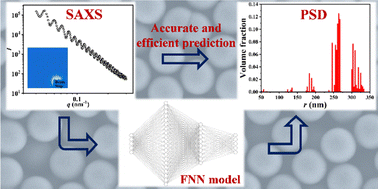
Small-angle X-ray scattering (SAXS) is widely used for characterizing the particle size distribution (PSD) at the mesoscale. Conventional extraction of PSD from SAXS data typically relies on traditional numerical methods such as Monte Carlo algorithms. However, these approaches often suffer from low computational efficiency and inherent difficulties in resolving complex multimodal distributions, thus limiting their applicability in high-throughput or real-time SAXS data analysis. To overcome these limitations, here we develop a feed-forward neural network (FNN) model for the accurate and efficient PSD analysis. By embedding physical constraints via iterative fine-tuning, the FNN model yields physically plausible predictions and resolves key PSD features accurately, including peak positions, peak widths, and low-abundance subpopulations for both simulated and experimental SAXS data. Validation against synchrotron radiation SAXS measurements and scanning electronic microscopy (SEM) characterization of silica and polystyrene nanoparticles shows strong agreement with PSDs obtained from the Monte Carlo algorithm (McSAS) and direct imaging analysis. Importantly, the FNN model achieves approximately 1800-fold acceleration in computation speed with a processing time of ∼50 ms per one-dimensional scattering curve, far surpassing the conventional McSAS method while maintaining robust predictive performance for both monodisperse and polydisperse systems. This work provides a practical tool for the rapid, high-precision analysis of complex particle systems in materials science and nanotechnology, partially addressing the long-standing challenge of real-time scattering data analysis.
 Please wait while we load your content...


