


 PLATFORM UPDATE:


Photomolecular rotor dynamics of the oxindole-based photoprotective bacterial pigment violacein
 a
Khalid M.
Siddiqui,
a
Eleanor K.
Ashworth,
a
Pratip
Chakraborty,
a
Dipanjan
Banerjee,
a
Erico M.
Braun,
ab
Stephen R.
Meech
a
and
James N.
Bull
*a
a
Khalid M.
Siddiqui,
a
Eleanor K.
Ashworth,
a
Pratip
Chakraborty,
a
Dipanjan
Banerjee,
a
Erico M.
Braun,
ab
Stephen R.
Meech
a
and
James N.
Bull
*a
Abstract
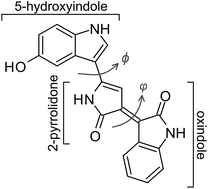
Conjugated molecules incorporating the oxindole motif offer a versatile scaffold for designing high-performance, light-responsive materials that exploit photomolecular rotor motion. Violacein, a purple coloured oxindole-based pigment produced by bacterial strains in superglacial Antarctic ice melts, serves as a natural photoprotectant. Using ultrafast spectroscopy combined with explicitly-solvated potential energy surfaces, we characterise the excited-state relaxation mechanism in violacein to involve initial relaxation to planar locally excited (LE) state(s), followed by passage through a twisted charge-transfer (CT) state along the molecular rotor coordinate to a nearby isomerising-like conical intersection seam. Propagation over the excited-state barrier connecting the LE and CT states along the photomolecular rotor axis leads to a strong viscosity dependence of the excited state lifetimes (ca. 4 ps in acetonitrile and 100 ps in ethylene glycol). These dynamics, leading to efficient electronic-to-vibrational energy conversion, coupled with a fast rate for thermal conversion of the possible Z photoisomer back to the starting E isomer, confer violacein with desirable photoprotectant properties.
 Please wait while we load your content...


