


 PLATFORM UPDATE:


Ionic liquid conductivity models by symbolic regression
 *a
and
Patrik
Johansson
abc
*a
and
Patrik
Johansson
abc
Abstract
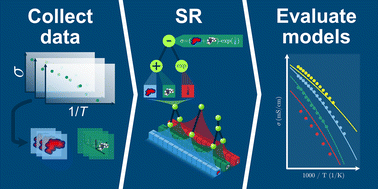
Organic solvents and fluorinated Li-salts is the basis of lithium-ion battery electrolytes, and it has remained unchanged for decades despite significant drawbacks such as thermal instability and high vapour pressure. One alternative is ionic liquid (IL) based electrolytes. However, the mechanism(s) that govern ion transport in IL based electrolytes, a property crucial for battery performance, is not yet fully understood. We here suggest a novel approach to model the ionic conductivity of ILs themselves; using symbolic regression (SR) to find analytical expressions derived from free volume theory (FVT). Using molecular descriptors as model inputs, we find several FVT-based models that show high correlations: R2 = 0.97 and R2 = 0.94 for the training and validation set, respectively, for an experimental dataset of 22 ILs measured in-house. Moving towards a significantly larger dataset, using data on 338 ILs from 125 publications, we find that our best model has a significantly higher spread in prediction accuracy but still shows appreciable performance for many ILs (R2 = 0.76 and R2 = 0.73 for the training and validation set, respectively). Overall, the FVT derived models perform best for “good” ILs, i.e. with well-dissociated ions, and worse for those ILs with strong ion–ion interactions. Using data from many publications impacts model performance, likely due to significant variations in e.g. impurities and dryness, as well as experimental set-ups and conditions.
 Please wait while we load your content...


