


 PLATFORM UPDATE:

Approximate quantum circuit compilation for proton-transfer kinetics on quantum processors
 *ab
Dilhan
Manawadu,
c
Stefan
Knecht,
g
Fabijan
Pavošević,
g
Francesco
Tacchino,
j
Ivano
Tavernelli,
j
Lars
Tornberg
a
and
Anders
Broo
a
*ab
Dilhan
Manawadu,
c
Stefan
Knecht,
g
Fabijan
Pavošević,
g
Francesco
Tacchino,
j
Ivano
Tavernelli,
j
Lars
Tornberg
a
and
Anders
Broo
a
Abstract
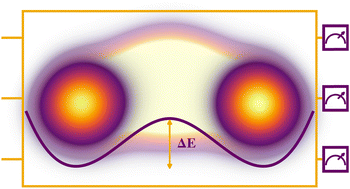
Proton transfer reactions are central to chemical and biological systems, where quantum effects—such as tunneling, delocalization, and zero-point motion—critically influence reaction kinetics. Classical methods that capture these phenomena scale poorly with system size, limiting their applicability. Here, we extend and benchmark a quantum computing framework based on the Nuclear–Electronic Orbital formalism, treating the transferring proton quantum mechanically, to assess the feasibility of computing accurate energy barriers on current quantum devices. Using malonaldehyde as a prototypical system, we construct deep initial circuits via ADAPT-VQE combined with the frozen natural orbital approximation and apply adaptive approximate quantum compiling to balance circuit depth and fidelity. Transpiling these circuits for the ibm_pittsburgh device and simulating with realistic noise models, we compute barrier heights and delocalized proton densities along the reaction pathway. Circuit refinement and compression yield compact representations that preserve essential quantum features of the transfer process. Notably, our shallowest circuits (AQC-low) reproduce key qualitative features, such as proton density localization, and are near the frontier of feasibility for current hardware. In contrast, deeper circuits (AQC-high) retain higher fidelity to reference barrier height, reducing the error to 1.6 mHa (13%) while still yielding a 98% underestimation of the rate constant at 120 K.
 Please wait while we load your content...


