


 PLATFORM UPDATE:


Impact of fluorine substitution position on triarylamine-based hole transport materials in perovskite solar cells
 abc
and
Toshinori
Matsushima
*abcd
abc
and
Toshinori
Matsushima
*abcd
Abstract
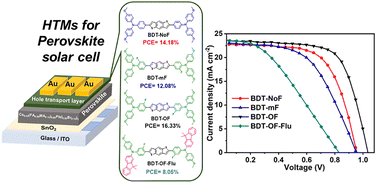
The molecular engineering of organic hole-transporting materials (HTMs) plays a crucial role in enhancing both the performance and stability of perovskite solar cells (PSCs). In this study, we investigated the impact of fluorine (F) substitution at different positions (ortho or meta) on the triarylamine donor unit connected to a benzo[1,2-b:4,5-b′]dithiophene (BDT) core. Four donor–π–donor type HTMs were designed and synthesized: BDT-NoF [4,4′-(benzo[1,2-b:4,5-b′]dithiophene-2,6-diyl)bis(N,N-bis(4-methoxyphenyl)aniline)], BDT-mF [4,4′-(benzo[1,2-b:4,5-b′]dithiophene-2,6-diyl)bis(2-fluoro-N,N-bis(4-methoxyphenyl)aniline)], BDT-OF [4,4′-(benzo[1,2-b:4,5-b′]dithiophene-2,6-diyl)bis(3-fluoro-N,N-bis(4-methoxyphenyl)aniline)], and BDT-OF-Flu [N,N′-(benzo[1,2-b:4,5-b′]dithiophene-2,6-diylbis(2-fluoro-4,1-phenylene))bis(N-(4-methoxyphenyl)-9,9-dimethyl-9H-fluoren-2-amine)]. The chemical structures, optical and electrochemical properties, film morphologies, and device performances of these HTMs were thoroughly characterized. The positional variation of the fluorine substituents induced distinct intramolecular noncovalent interactions that influenced the optoelectronic behavior and charge-transport properties. Devices employing BDT-NoF, BDT-mF, BDT-OF and BDT-OF-Flu achieved average power conversion efficiencies (PCEs) of 14.9%, 12.4%, 16.7%, and 8.0%, respectively. Notably, BDT-OF exhibited the highest power conversion efficiency (16.7%), among the series, due to favorable packing characteristics, promoting pinhole-free film formation and efficient charge extraction. These findings indicate that position of fluorine substitution and the choice of terminal aryl group significantly affect the energy-level alignment, molecular packing, and interfacial contact with the perovskite layer. This study provides valuable insights into the rational molecular design of HTMs, emphasizing the importance of fluorine positioning and structural engineering for optimizing PSC efficiency and stability.
- This article is part of the themed collection: 2026 PCCP HOT Articles
 Please wait while we load your content...


