


 PLATFORM UPDATE:


Strongly anisotropic optoelectronic properties and long exciton lifetimes in two-dimensional GaInS3-type monolayers
 ab
Xiaolin
Wei
*ab
ab
Xiaolin
Wei
*ab
Abstract
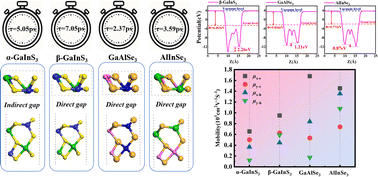
Two-dimensional (2D) layered GalnS3 materials have attracted huge attention due to their excellent anisotropic photoelectric properties for photovoltaic devices. However, the monolayer α-GaInS3 possesses an indirect band gap, which significantly limits its practical applications. Therefore, we constructed non-centrosymmetric GalnS3-like monolayers, namely, ABM3 (A = Ga, In, Al; B = Ga, In, Al; M = S, Se, Te), and investigated their electronic and excitonic properties using high-precision G0W0-BSE methods. Our results indicated that β-GaInS3, GaAlSe3, and AlInSe3 monolayers possess direct band gaps with desirable structural stability. Moreover, the built-in electric potential differences of these non-centrosymmetric monolayers can promote the separation of photon-generated carriers. Importantly, the three ABM3 monolayers exhibit larger exciton binding energy with a BSE optical band gap in the visible light range, and their exciton lifetime is up to 7.05 ps for β-GaInS3 at 0 K. In addition, these three structures exhibit highly anisotropic electron mobilities (up to ∼103 cm2 V−1 s−1) due to their larger lattice anisotropy.
 Please wait while we load your content...


