


 PLATFORM UPDATE:


DFT analysis of the structural, electronic, magnetic and thermoelectric properties of X2NbI6 (X = Ga, In) vacancy-ordered double perovskites
 *a
*a
Abstract
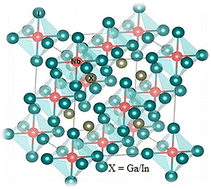
First-principles calculations based on density functional theory and classical Boltzmann theory were used to study the structural, electronic, magnetic, and spin-dependent thermoelectric characteristics of X2NbI6 (X = Ga, In) vacancy-ordered perovskites. By calculating their tolerance factors, it was confirmed that these compounds exhibit cubic phase stability. From the volume optimization procedure, it was revealed that they are ferromagnetic. Additionally, the negative formation energies suggest that a thermodynamically stable form of X2NbI6 might be produced. The structural properties, namely the lattice constant and bulk modulus, were found to increase with the replacement of In instead of Ga at the X site. The electronic properties and integral values of total magnetic moments demonstrated the half-metallic nature of X2NbI6. The ferromagnetic nature and 100% spin polarizability revealed the feasibility of using X2NbI6 in the spintronic industry. The effective use of X2NbI6 as thermoelectric materials in the spin Seebeck effect was demonstrated by their spin-dependent thermoelectric properties.
 Please wait while we load your content...


