


 PLATFORM UPDATE:

Ab initio potential energy surface of NC4N−He: rotationally inelastic collisions and rate coefficients

Abstract
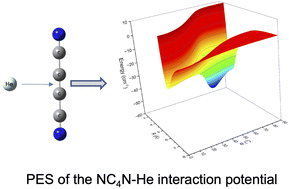
The rotational dynamics at the quantum level of dicyanoacetylene (NC4N) with helium (He) is studied in the temperature range of 1–100 K. Cross sections for the rotational transitions are obtained and used in the estimation of the rate coefficients. An ab initio-derived potential energy surface (PES) for the NC4N−He system was generated at the CCSD(T)/aug-cc-pVTZ level of theory, considering NC4N as a rigid rotor. The PES exhibits a global minimum with a well-depth of −43.84 cm−1 and an angle of 67.5°. Legendre expansion coefficients were obtained through analytical fitting and subsequently employed in the calculation of rotational cross sections. The first bending vibration for the NC4N molecule is at 107 cm−1, and cross sections were computed for collisional energies up to 107 cm−1 using the close-coupling method. Resonances are observed in cross sections for lower collisional energy. The rate coefficients were calculated for temperatures ranging from 1 to 100 K. In the NC4N–He collision system, rotational transitions corresponding to Δj = 2 are the most prevalent and exhibit higher rate coefficients compared to other transitions. The new rate coefficients obtained will help to accurately interpret NC4N rotational spectra and abundance in interstellar clouds.
- This article is part of the themed collection: Structure and dynamics of chemical systems: Honouring N. Sathyamurthy’s 75th birthday
 Please wait while we load your content...


