


 PLATFORM UPDATE:


Dynamics in renewable sourced random poly(trimethylene 2,5-furanoate-co-trimethylene suberate) copolymers: ambient-pressure fragility and compensation law in secondary relaxations

Abstract
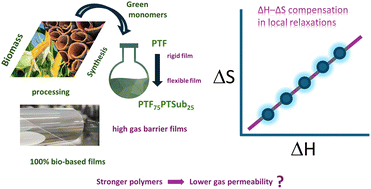
This article presents an experimental study on the relaxation dynamics in a series of random copolymers with optimum gas barrier properties based on bio-friendly monomers. The relaxation response of poly(trimethylene 2,5-furanoate-co-trimethylene suberate) copolymers is examined in the glassy and viscoelastic regime via frequency-domain spectroscopies (dielectric and mechanical). We report lower values of dynamic fragility, a dimensionless index introduced in 1985 [C. A. Angell, Relaxations in Complex Systems, ed. K. Ngai and G. B. Wright, National Technical Information Service, US Department of Commerce, Springield, VA, 1985, p. 3; C. A. Angell, Formation of glasses from liquids and biopolymers, Science, 1995, 267(5206), 1924–1935], in comparison to conventional polyesters used in industry, such as poly(ethylene terephthalate). We propose that this is consistent with their low permeability to gases. The sub-glass dynamics is complex and can be described by two local modes, β1 and β2, whereas for poly(trimethylene 2,5-furanoate) and the copolymer with the lowest suberate unit content we detect a single β relaxation. Our study reveals that sub-Tg relaxations obey the so-called compensation law, which is interpreted with respect to the multiexcitation entropy model by Yelon and Movaghar, and the more recent collective small displacements model.
 Please wait while we load your content...


