


 PLATFORM UPDATE:


Theoretical study on the analyzability of modified convex regression for radical reaction
 *a
and
Masanori
Tachikawa
a
*a
and
Masanori
Tachikawa
a
Abstract
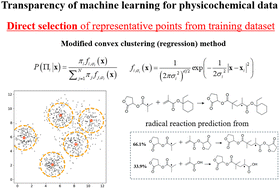
Analyzing data and extracting meaningful insights is essential across various research fields. To address acrylate and methacrylate radical reaction data, we propose a modified convex clustering (regression) method, in which representative points are directly selected from the training data to describe the dataset. Although machine learning (ML) models are often regarded as black boxes, making their predictions difficult to interpret, the (modified) convex clustering approach allows for straightforward analysis of model behavior. This study emphasizes the importance of selecting representative points to enhance the interpretability and transparency of ML models. We demonstrate that radical reaction energy barriers can be effectively described and predicted based on the contributions of similar reactions. The simplicity and transparency of the modified convex clustering (regression) method enable in-depth analysis of physicochemical data.
 Please wait while we load your content...


