


 PLATFORM UPDATE:


Layer-dependent friction on the surface of alternately stacked graphene and h-BN
 *a
*a
Abstract
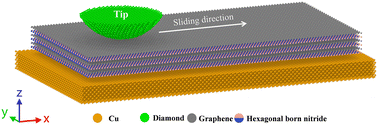
Two-dimensional materials have great potential as lubricating coatings on metal surfaces. This work investigates the performance of alternately stacked graphene and h-BN as lubricating coatings via molecular dynamics (MD) simulations. Our results indicate that stacking with graphene enhances the lubrication of h-BN, and the alternately stacked graphene and h-BN with graphene as the surface (mGBN_G) exhibits better lubricating and anti-wear properties than graphene. The friction coefficient on the surface of mGBN_G changes non-monotonically with the layer number, mainly attributed to wrinkling, indentation, and differences in the elastic–plastic deformation of the Cu substrate caused by the pressure from the tip. The 6GBN_G is optimal with high out-of-plane stiffness, and its friction coefficient is as low as 0.002 under 180 nN normal load, even lower compared with graphene with the same layer number. Differential charge density calculations reveal that C/B/N electronegativity differences induce interface charge transfer, enhancing interlayer van der Waals interactions, and improve the overall shear strength and mechanical properties. Notably, 6GBN_G maintains an ultra-low friction (μ < 0.002) at temperature ≤300 K, normal loads of 170–200 nN, and sliding velocity <0.2 Å ps−1. These findings provide crucial guidance for the design of high-performance lubricating coatings.
 Please wait while we load your content...


