


 PLATFORM UPDATE:


The limit of the current aromaticity concept

Abstract
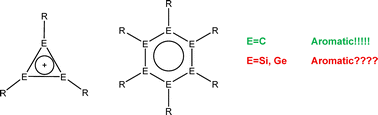
We investigated the aromatic properties of a set of fifteen cyclic 2π-electron systems and nine 6π-electron charged and neutral systems composed of second-, third-, and fourth-row elements. Three criteria for assessing aromaticity were applied: magnetic (including three variants of the NICSπ,zz method and current-density analysis), electron-density-based (using the MCI and MCIπ indices), and energetic (via the BLW method, the simplest form of valence-bond theory). The results reveal that the aromaticity rankings produced by these approaches often diverge, with no clear correlation among the three methods. Aromaticity is not an explicit component of the Hamiltonian or the wavefunction; it is inferred solely through indices and indicators. The absence of correlation between different aromatic measures suggests that establishing aromaticity for systems beyond the second row is intrinsically challenging. More fundamentally, the inconsistencies observed among traditional aromaticity criteria for systems composed of second-row elements in their heavier congeners raise the possibility that aromaticity may not exist beyond the second row. At present, this remains an open question. Noticeably, our findings indicate that NICS values should not be used as a “black box” measure of aromaticity.
 Please wait while we load your content...


