NMR-based conformational analysis of DNA G-quadruplex guides mapping essential structure-function relationship in protein chaperoning

Abstract

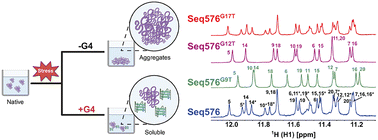
G-quadruplexes (G4s) are increasingly recognized to chaperone proteins, warranting structure-function relationship studies. In this study, we apply solution NMR methods to determine the topology and base-level resolution structure of a G-rich DNA sequence with protein chaperoning activity (referred to as Seq576) without chemical shift assignments. Seq576 samples two conformations, in the slow exchange timescale, arising due to a G-register shift. Using the structural insights of Seq576, we then perform structure-function studies via mutation and chaperone assays to investigate the G4 properties essential for chaperoning protein aggregation and folding. These studies highlight the possibility of using a construct design to perform in-depth nucleic acid structural biology investigation using inexpensive and fast NMR experiments to obtain and analyze function, such as residue-level investigation of chaperone activity.
Supplementary files

Article information

Article type
Paper
Submitted
10 Oct 2025
Accepted
11 Dec 2025
First published
22 Dec 2025
This article is Open Access
Creative Commons BY-NC license

Phys. Chem. Chem. Phys., 2026, Accepted Manuscript

NMR-based conformational analysis of DNA G-quadruplex guides mapping essential structure-function relationship in protein chaperoning

D. Negi, Z. Huang, A. Son, B. Sathyamoorthy and S. Horowitz, Phys. Chem. Chem. Phys., 2026, Accepted Manuscript , DOI: 10.1039/D5CP03909F

This article is licensed under a Creative Commons Attribution-NonCommercial 3.0 Unported Licence. You can use material from this article in other publications, without requesting further permission from the RSC, provided that the correct acknowledgement is given and it is not used for commercial purposes.

To request permission to reproduce material from this article in a commercial publication, please go to the Copyright Clearance Center request page.

If you are an author contributing to an RSC publication, you do not need to request permission provided correct acknowledgement is given.

If you are the author of this article, you do not need to request permission to reproduce figures and diagrams provided correct acknowledgement is given. If you want to reproduce the whole article in a third-party commercial publication (excluding your thesis/dissertation for which permission is not required) please go to the Copyright Clearance Center request page.

Read more about how to correctly acknowledge RSC content.

Social activity

Spotlight

Advertisements