


 PLATFORM UPDATE:


Riboflavin – understanding the dynamics and interactions of the triplet state

Abstract
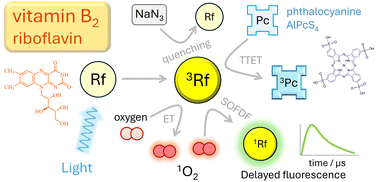
Riboflavin, a water-soluble vitamin and important nutrient found in many foods, also functions as an effective photosensitiser, with a singlet oxygen quantum yield of 0.54. This makes it relevant not only for photodynamic therapy (PDT) but also as a contributor to light-induced degradation of food and beverages. However, literature reports on its triplet and singlet oxygen dynamics remain inconsistent. We show that in phosphate buffered water, riboflavin exhibits a triplet state lifetime of 3.2 µs and a singlet oxygen lifetime of 3.7 µs, unusually close values that require careful kinetic analysis for a correct interpretation. Contrary to some assumptions, we find that sodium azide efficiently quenches riboflavin triplets (rate constant 4 × 10⁹ M−1 s−1), far exceeding the quenching rate of azide for singlet oxygen. In contrast, we demonstrate that the quenching of singlet oxygen by riboflavin is negligible under typical conditions in H2O. We also report pronounced delayed fluorescence (DF) of riboflavin in air-saturated samples, attributed to the singlet oxygen feedback mechanism. Finally, we discuss how the DF signal can be used to reveal energy transfer efficiency to other sensitisers, such as aluminium phthalocyanine, where we demonstrate a dominant role of the triplet–triplet transfer mechanism.
 Please wait while we load your content...


