


 PLATFORM UPDATE:


Towards a hybrid semi-quasi-classical trajectory method for the accurate calculation of vibrationally inelastic probabilities in atom–diatom collisions

Abstract
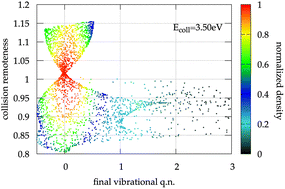
The quasiclassical trajectory method (QCT) for molecular dynamics is routinely used for the calculation of complete sets of cross sections and rate coefficients in vibrationally inelastic collision processes concerning air molecular species. Such processes are key for kinetic models of interest in accurate simulations of practical relevance, such as green fertilizer production by non-equilibrium (or cold) plasmas. This popularity is due to the general good compromise of QCT between accuracy and computational effort required. However, QCT at low total energy often fails to accurately describe low-probability vibrationally inelastic processes. The major impact of QCT data inaccuracy in cold plasma modeling is caused not by poor statistics associated with low probability events nor barrier tunneling, but by the inadequacy of QCT to capture some vibrational distribution features in the final products. The recently introduced collision remoteness concept allows a clear-cut distinction between purely nonreactive and quasireactive regimes. The first, where transition probabilities are often small, is easily treated accurately by semiclassical (SC) methods. The quasireactive regime is well modelled by QCT. This suggests a possible merging of QCT with a suitable SC method, with a reasonable capture of the most accurate partial result of each method. A first proposal of a merging procedure is presented here, with an excellent level of agreement with both accurate quantum-mechanical (QM) time-independent and time-dependent close-coupling calculations for vibrationally inelastic O + N2 collisions. This level of agreement is far better than the one found using the QM coupled states approximation in the same conditions. Accurate QM treatment of air species with the level of vibrational detail required by kinetic simulations, including air species, is prohibitively far from computational feasibility, so development of accurate approximations remains crucial. The details of the hybrid method and its possible impact on modelling of non-equilibrium plasmas of technological interest are discussed.
 Please wait while we load your content...


