


 PLATFORM UPDATE:


Electronic band gap engineering of pyrene-based α-graphyne through chemical functionalization and mechanical strain

Abstract
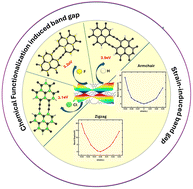
Two-dimensional (2D) carbon allotropes beyond graphene, particularly graphynes, offer versatile platforms for tuning structure–property relationships in mixed sp–sp2 hybridized lattices. Here, we introduce pyrene-based α-graphyne, a novel derivative constructed via selective linker removal and hydrogen passivation, embedding extended aromatic domains while preserving the α-topology. Density functional theory calculations (PBE-GGA) confirm dynamic and thermal stability up to 2000 K, supported by phonon dispersion and ab initio molecular dynamics simulations. Mechanical analysis reveals high stiffness (Young's modulus ∼174 N m−1; shear modulus ∼71 N m−1) and a nearly isotropic elastic response. The pristine lattice exhibits Dirac-like semimetallicity. The hexagonal lattice was transformed into an equivalent orthorhombic supercell, allowing uniaxial compressive and tensile strains along armchair and zigzag directions. Under ±3% strain, a finite band gap emerges symmetrically in the meV regime. Along the zigzag direction, the gap reaches 18.6 meV (−3%) and 11.2 meV (+3%), while along the armchair direction it increases to 20.0 and 14.3 meV, respectively. For equal strain magnitudes, the larger response under armchair deformation reflects stronger modulation of pz–pz orbital overlap and strain-induced lifting of Dirac-point degeneracy. Chemical functionalization provides an additional degree of control: selective hydrogenation and fluorination at sp2 sites stabilize wide band gaps of 3.93 eV and 3.21 eV, respectively, while complete chlorination destabilizes the lattice due to steric crowding and out-of-plane distortions. Gas adsorption analysis further reveals strong, site-dependent binding for small molecules (Cl2, F2, NO, O2, and CO2), highlighting chemically active acetylenic regions. Together, these results establish pyrene-based α-graphyne as a mechanically robust, strain-tunable, and chemically responsive 2D carbon framework.
 Please wait while we load your content...


