A time-, angle- and kinetic-energy-resolved photoelectron spectroscopic study of tetrakis(dimethylamino)ethylene

Abstract

The ultrafast electronic relaxation dynamics of tetrakis(dimethylamino)ethylene (TDMAE) following photoexcitation at ∼267 nm is investigated using the time-, angle- and kinetic-energy-resolved photoelectron spectroscopy method, since we are motivated by the experimental findings in a previous similar study (E. Gloaguen et al., J. Am. Chem. Soc., 2005, 127, 16529–16534). Based on the detailed analysis of the current high-quality data, the lifetime of the initially prepared ππ* state is found to be 50 ± 10 fs and it is clearly evident that an intermediate Rydberg state with a lifetime of 550 ± 50 fs plays a pivotal role in the photodynamics of TDMAE. In addition, a partial wave packet revival is also observed with a period of ∼500 fs. This coherent oscillation, which is attributed to a vibrational quantum beat associated with overtones of the low-frequency C–C twist vibration in TDMAE, survives the ultrafast internal conversion processes and finally damps on a time scale of the order of several picoseconds.
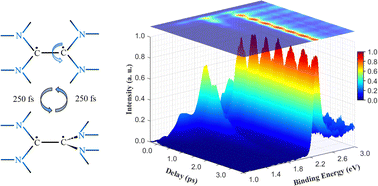
Graphical abstract: A time-, angle- and kinetic-energy-resolved photoelectron spectroscopic study of tetrakis(dimethylamino)ethylene

Supplementary files

Article information

Article type
Paper
Submitted
05 Oct 2025
Accepted
13 Nov 2025
First published
14 Nov 2025
This article is Open Access
Creative Commons BY-NC license

Phys. Chem. Chem. Phys., 2026, Advance Article

A time-, angle- and kinetic-energy-resolved photoelectron spectroscopic study of tetrakis(dimethylamino)ethylene

Y. Tian, Z. Chen, W. Wu, L. Wang, Z. He, D. Yang, G. Wu and X. Yang, Phys. Chem. Chem. Phys., 2026, Advance Article , DOI: 10.1039/D5CP03850B

This article is licensed under a Creative Commons Attribution-NonCommercial 3.0 Unported Licence. You can use material from this article in other publications, without requesting further permission from the RSC, provided that the correct acknowledgement is given and it is not used for commercial purposes.

To request permission to reproduce material from this article in a commercial publication, please go to the Copyright Clearance Center request page.

If you are an author contributing to an RSC publication, you do not need to request permission provided correct acknowledgement is given.

If you are the author of this article, you do not need to request permission to reproduce figures and diagrams provided correct acknowledgement is given. If you want to reproduce the whole article in a third-party commercial publication (excluding your thesis/dissertation for which permission is not required) please go to the Copyright Clearance Center request page.

Read more about how to correctly acknowledge RSC content.

Social activity

Spotlight

Advertisements