


 PLATFORM UPDATE:


Nano IR spectroscopy on silicon-supported organic–inorganic hybrid materials

Abstract
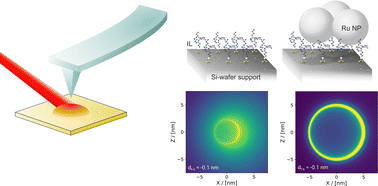
We study a recently developed model system for multifunctional catalysts consisting of Ru nanoparticle covered supported ionic liquid phases (RuNP@SILP). In order to learn about the nanostructure of this system photothermal nano-IR spectroscopy (AFM-IR) is applied here. Studying such molecular monolayers using AFM-IR has proven challenging with success mostly limited to gold substrates, due to gold's intrinsic field enhancement. In contrast, the application of AFM-IR to ultrathin layers on Si|SiO2 substrates as used in this study for the SILPs has not yet been reported. Here, we approach this challenge and employ AFM-IR and nano-optics simulations using the finite element method. We demonstrate that good S/N ratio AFM-IR spectra can be obtained for monolayers on Si|SiO2 and that, in the case of metal overlayers, the underlying monolayer's IR absorbance is determined by the structure of the metal overlayer. Ultimately, this approach leads to novel insights on the nanostructure of SILPs and RuNP@SILPs and can be applied more broadly to the larger class of molecularly modified surfaces.
 Please wait while we load your content...


