


 PLATFORM UPDATE:


Libration of hydroxyl groups in layered aluminum (oxy)hydroxides and other material analogs: insights from inelastic neutron scattering and theory
 *a
Micah P.
Prange,
*b
Trent R.
Graham,
b
Xin
Zhang,
b
Tingting
Liu,
a
Alexander I.
Kolesnikov,
c
Gregory K.
Schenter,
b
Lawrence M.
Anovitz,
a
Kevin M.
Rosso
b
and
Carolyn I.
Pearce
bd
*a
Micah P.
Prange,
*b
Trent R.
Graham,
b
Xin
Zhang,
b
Tingting
Liu,
a
Alexander I.
Kolesnikov,
c
Gregory K.
Schenter,
b
Lawrence M.
Anovitz,
a
Kevin M.
Rosso
b
and
Carolyn I.
Pearce
bd
Abstract
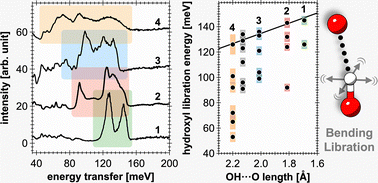
We analyzed the hydroxyl librational signatures of five structurally related aluminum (oxy)hydroxides, using inelastic neutron scattering (INS) and plane-wave lattice dynamics simulations. A clear trend across these aluminum-containing phases illustrates the relationship between hydrogen bonding, local atomic structure, and the spectral location and profile of the librational bands. The INS spectra have been compared to previous optical spectroscopy and computational studies, highlighting the complementary nature of the INS technique. Taking into account other structurally or chemically related material analogs, we have identified a correlation between a blueshift (to higher energy) of the upper librational band edge and the geometry of the hydrogen bond interactions, mirroring (with opposite correlation) the well-known redshift in the intramolecular O–H stretching energy with increasing hydrogen bond strength. For hydroxyl groups that do not participate in hydrogen bonding effectively, the bending librations occur at lower energies and hybridize with metal–oxygen lattice modes. Standard density functional theory approximations, including dispersion corrections, struggle to correctly predict vibrational frequencies of motions dominated by H but perform well for metal–oxygen modes, allowing us to make detailed mode assignments in several cases, including a demonstration of how layer-to-layer disorder in boehmite hydrogen bond orientations is reflected in the sharp but minor low energy peaks (at ∼70–80 meV) of the INS spectrum.
 Please wait while we load your content...


