


 PLATFORM UPDATE:


Substituent-controlled quantum interference tuning of spin and thermoelectric transport in triphenylmethyl diradical junctions
 *b
*b
Abstract
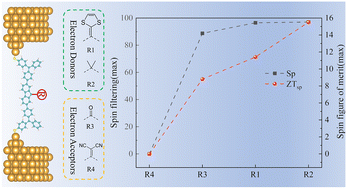
Achieving effective control of spin and thermoelectric transport at the molecular scale remains a key challenge for advancing next-generation molecular devices. In this study, we employ density functional theory (DFT) combined with the non-equilibrium Green's function (NEGF) method to systematically investigate the spin-resolved charge and thermoelectric transport properties of diradical molecular junctions, in which two triphenylmethyl (TPM) cores are symmetrically bridged by fluorene units functionalized with four different substituents. The results demonstrate that substituent-modulated charge transfer at the molecule–electrode interface can effectively regulate the spin transport properties of the molecular junction, leading to pronounced spin filtering and tunnel magnetoresistance effects. Furthermore, the characteristics of quantum interference and the resonance orbitals near the Fermi level (EF) are highly sensitive to the nature of the substituents, resulting in significant variations in conductance and the Seebeck coefficient that synergistically enhance the thermoelectric performance. These findings provide guidelines for designing multifunctional molecular devices with enhanced spintronic and thermoelectric functionalities.
 Please wait while we load your content...


