


 PLATFORM UPDATE:

Unexpected dynamics of peptoid-conjugated dyad systems: ultrafast photoinduced electron transfer in off-facial arrangement

Abstract
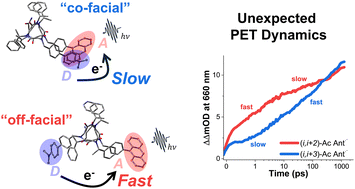
Peptoids (oligo-N-substituted glycines) offer a promising scaffold for photophysical platforms enabling precise control over the geometry between electron acceptor (A) and donor (D) moieties. In this study, we synthesized two peptoid dyads with an anthracene acceptor and an N,N-dimethylaniline donor, designed to adopt co-facial (i,i + 3)-Ac and a distant off-facial (i,i + 2)-Ac. Initial photophysical characterization presented a puzzle: while steady-state measurements confirmed different spectra for both systems, their nanosecond fluorescence decay kinetics were unexpectedly similar. This finding was unanticipated given their distinct structures, confirmed by circular dichroism spectroscopy and density functional theory (DFT) calculations, which revealed helical secondary structures and a close D–A proximity (∼5 Å) in the co-facial (i,i + 3)-Ac versus a large separation (∼14 Å) in the off-facial (i,i + 2)-Ac system. Moreover, time-dependent DFT calculations suggested that (i,i + 2)-Ac requires more structural reorganization to form an exciplex than (i,i + 3)-Ac. This structural evidence led to an expectation of much faster photoinduced electron transfer (PET) in the (i,i + 3)-Ac dyad. To resolve this inconsistency, we investigated the dynamics on an ultrafast timescale using femtosecond transient absorption (fsTA) and fluorescence upconversion. Counterintuitively, these experiments showed that the off-facial (i,i + 2)-Ac system undergoes faster initial PET at early times (<∼10 ps) than its co-facial counterpart. This trend was also observed in a higher-viscosity solvent (dimethyl sulfoxide), supporting the possibility that ground-state conformational heterogeneity, rather than rapid post-excitation reorganization, contributes to the observed kinetics. These findings highlight the importance of considering heterogeneous conformational ensembles for the rational design of functional peptoid scaffolds in applications where precise control over electron transfer is essential.
 Please wait while we load your content...


