


 PLATFORM UPDATE:


Host–guest interaction of NO and NO+ species with calixerenes: dissecting the impact of conformational and confinement effects†

Abstract
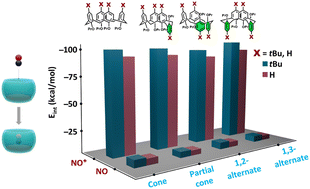
Calixarenes have emerged as a promising molecular platform for the sensing of nitric oxide (NO), due to their characteristic host–guest interaction capabilities. Understanding the noncovalent interactions present in NO-bound calixarene complexes provides valuable insight for the rational design of selective NO-binding systems and for elucidating the biological functions of NO. In this study, dispersion corrected DFT calculations were employed to investigate the variations in energetics and electronic properties of neutral and cationic NO encapsulated within a calix[4]arene propyl ether derivative across four distinct conformers: cone, partial cone, 1,2-alternate, and 1,3-alternate. The subtle interplay of various noncovalent interactions between NO/NO+ and these conformers was analyzed using molecular electrostatic potential (MESP), atomic dipole-moment corrected Hirshfeld (ADCH), quantum theory of atoms in molecules (QTAIM), and an independent gradient model based on Hirshfeld partition (IGMH) analyses. Our analysis indicates that NO preferentially interacts with benzene rings in a parallel orientation, with (NO)⋯π interactions representing the strongest noncovalent contribution in the NO–calixarene complexes. For NO+ species, N-end binding leads to greater stabilization when interacting with a single phenyl moiety, whereas O-end binding results in comparatively less stable interactions with the corresponding moiety. This difference in interaction preference leads to a parallel orientation of NO+ when confined within two cofacial phenyl rings. In addition, we quantified the confinement effect produced by the tert-butyl group on the upper rim of all conformers of the calixarene system, and the results suggest that the host molecule with bulky groups can stabilize NO and NO+ more effectively, with the NO+ complex being significantly more stable. The current investigation offers fundamental insights into how the interplay of diverse noncovalent interactions involving NO and NO+ contributes to their selective binding to various biological receptors.
- This article is part of the themed collection: Structure and dynamics of chemical systems: Honouring N. Sathyamurthy’s 75th birthday
 Please wait while we load your content...


