


 PLATFORM UPDATE:


Photochemical transformation of weakly absorbing organics by visible light in microdroplets

Abstract
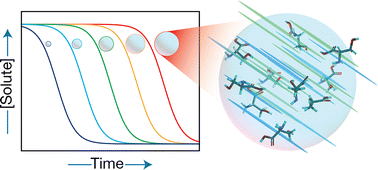
Microdroplets provide a solute environment where concentrations readily surpass bulk saturation limits. How this persistent supersaturation influences reaction rates and photochemical pathways remains largely unexplored. Here, we investigate photochemical transformations of six “non-absorbing” organic molecules (glycine, proline, serine, glucose, ribose, and deoxyribose) in single aqueous microdroplets using optical trapping at two different laser wavelengths (473 and 532 nm). The contact-free environment allows for the suspension of supersaturated microdroplets, similar to those observed in natural aerosol particles in the atmosphere. In microdroplets containing water and the organic species, we observed photochemical transformations at optical wavelengths for all solutes. The organic molecules considered here are typically known to absorb light in the UV range, specifically at wavelengths no longer than 200 nm. The observed timescales for these photochemical reactions scale with the droplet radius-squared. We expand upon a photochemical adaptation of the Finke–Watzky model to demonstrate that in all cases, volume-dependent photochemical reactions occur. Through systematic elimination of confounding factors, we establish that weak visible absorption in the low-energy tail of UV bands drives photochemistry across all of these organic solutes, demonstrating that extremely weak molar absorptivities can facilitate significant photochemical transformations in the confined environment of a microdroplet.
- This article is part of the themed collection: Showcasing the Breadth of Physical Chemistry Chemical Physics Research in Canada
 Please wait while we load your content...


